


What Is the Best Career Assessment for High School Students? (Here’s What Actually Works)
By Bridget Batson, Career Strategist | Founder, Houston Outplacement
The Question Every Parent Is Googling at 2 AM
“What is the best career assessment for my high school student?”
I see you. You’re watching your teenager navigate a world that’s asking them to make massive decisions with barely any life experience. Choose a college. Pick a major. Declare a path. And oh, by the way, don’t mess it up because college is expensive and changing directions feels like failure.
No pressure, right?
Here’s what I’ve learned after years of helping families (and plenty of burned-out adults who wish someone had helped them at 17): Most career assessments are asking your kid the wrong questions entirely.
Why Most Career Tests Fail Teenagers Spectacularly
Let’s talk about what’s actually happening when your high schooler takes one of those free online career quizzes.
The test asks: “Do you enjoy managing people?”
Your teenager thinks: I mean… I was in charge of the group project that one time? Does that count?
The test asks: “Do you prefer analytical work or creative work?”
Your teenager thinks: I like art class but I’m good at math. Is this a trick question?
Here’s the thing: Most career assessments are designed for people who already have careers. They’re asking about work preferences your teenager hasn’t experienced yet. They’re measuring skills instead of something way more important: interests.
And interests? Those stick around. They evolve slowly. They’re the real predictor of whether someone will still love their work in 10, 20, or 30 years.
The Career Planning Mistake Nearly Everyone Makes
Want to know the biggest mistake I see in career planning?
People choose based on what sounds good right now instead of what will sustain them later.
They pick the major that sounds impressive. The career their parents understand. The path that seems “safe” or prestigious. What they’re good at rather than what genuinely interests them.
And then, somewhere around age 28 or 35 or 42, they wake up and think: “I’m good at this. I make money doing this. So why do I feel so… stuck?”
Because skills can be taught. Interest drives everything else.
You can teach someone to be good at math. You cannot teach them to care about analyzing data for eight hours a day.
You can train someone in graphic design software. You cannot manufacture genuine interest in visual problem-solving.
Talent matters. But interest alignment? That’s the difference between a career you tolerate and a career that energizes you.
What Actually Matters When You’re 16 (Hint: Not Job Titles)
Let’s stop asking: “What job should my child choose?”
Instead, ask: “What interests will still matter to them 20 years from now?”
Because here’s what happens in 20 years: Job titles change. Industries evolve. Required skills shift. That “hot career” everyone wanted? Might not even exist anymore.
But interests? Those are your career foundation. And the earlier you understand them, the smarter every decision becomes, from college majors to internships to that first “real” job.
The Myers-Briggs Strong Interest Inventory® (And Why It’s Different)
Okay, I’m going to get specific here because this is where the rubber meets the road.
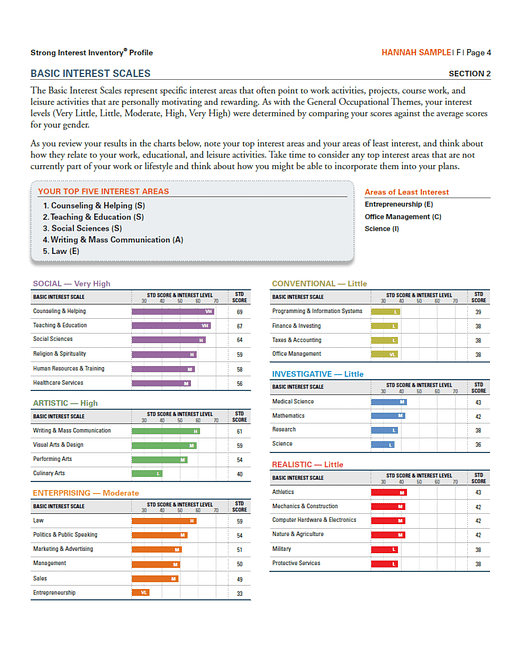
The Myers-Briggs Strong Interest Inventory® is not another 10-minute online quiz. It’s the career assessment I use with both high school students and the adults who wish someone had given them this assessment at 17.
View a Sample Report Here
 What Makes the Strong Interest Inventory Actually Work for Teens
 What Makes the Strong Interest Inventory Actually Work for Teens
It doesn’t require job experience. Your teenager doesn’t need to have worked in an office, managed a team, or completed an internship. The assessment measures what they’re naturally drawn to, not what they’ve already done.
It measures patterns, not single careers. Instead of spitting out “You should be a lawyer” or “You should be an engineer,” it shows clusters of aligned paths. Families of careers. Themes that repeat across industries.
It accounts for changing careers over time. Because let’s be real—your teenager is probably going to have multiple careers in their lifetime. This assessment helps them understand the types of environments and work that will keep showing up as a good fit.
It removes the guesswork. Instead of your kid trying to imagine what “project management” or “data analysis” feels like, the Strong shows them: Here are the work environments where people with your interests consistently thrive.
What It Looks Like in Real Life
Instead of saying: “You should be a doctor.”
The Strong Interest Inventory says: “Here are the types of work, environments, and roles that align with your interests—which might include healthcare, but also research, teaching, counseling, or policy work.”
See the difference? One locks doors. The other opens them.
For Parents: The Silent Fears You’re Carrying
Can we talk about what’s really keeping you up at night?
You’re not just wondering “What career should my child choose?”
You’re thinking:
- What if they pick the wrong major and we’re on the hook for $80,000 in loans?
- What if they burn out by 25 because they chose prestige over fit?
- What if I push them in the wrong direction because I don’t really understand what they need?
- What if they’re miserable and I could have helped them avoid this?
I get it. And here’s what a validated, research-backed interest assessment does:
It gives you a neutral foundation. Not based on what Uncle Bob thinks they should do, or what sounds impressive at the family reunion, but on decades of research into what actually predicts career satisfaction.
It creates language for family conversations. Instead of “I don’t know what I want to do” (which feels scary), you get “Here’s what consistently energizes me” (which feels productive).
It reduces expensive detours. Not because it locks your child into one path, but because it helps them avoid paths that were never going to fit in the first place.
This gives you a foundation for making informed decisions together, not guesses based on what sounds good.
“But My Kid Already Knows Where They’re Going to College”
Even better. Seriously.
Here’s why a Strong Interest Inventory matters even more if your teenager already has a plan:
Many students choose majors based on prestige, not fit. They pick what sounds good to other people, not what aligns with their interests. And that’s a recipe for either changing majors (expensive) or graduating into a career they don’t actually like (more expensive).
Interests often conflict with external expectations. Your kid might be “supposed to” go into business because they’re good at math, but their interests might point to environmental science or urban planning. Early awareness means they can make intentional choices—double majors, strategic electives, internships that test their assumptions.
Career regret rarely comes from lack of intelligence. It comes from lack of alignment. I’ve worked with brilliant people who are miserable. Not because they aren’t good at what they do, but because no one ever asked: Does this actually interest you?
For Adults Reading This: You’re Not Too Late (And You’re Not Broken)
Let me guess. You’re reading this article ostensibly “for your teenager,” but part of you is thinking:
I wish someone had given me this at 17.
Or: I’m 35 and I still don’t know what I want to do.
Or: I’m good at my job but I’m so, so tired.
Listen: You are not too late. And you are not broken.
The Myers-Briggs Strong Interest Inventory® is just as powerful for adults navigating career pivots, burnout, or that gnawing feeling that something’s off. I work with professionals all the time who are discovering—sometimes for the first time—what their interests actually are when external expectations are stripped away.
Your interests might have changed since you were 22. Or—more commonly—they were never considered in the first place.
Either way, there’s a path forward. And it starts with the same place it starts for teenagers: understanding what genuinely interests you, not what you think you should be interested in.
Why the Assessment Alone Isn’t Enough (Here’s Where Interpretation Matters)
Real talk: You can take the Strong Interest Inventory, get your results, and still have no idea what to do with them.
Because raw data without context is just… data.
This is why working with someone who actually knows how to interpret these results matters.
A trained career professional helps you:
- Translate abstract interest categories into real-world career options
- Navigate contradictions (because yes, you can have conflicting interests—most people do)
- Avoid overly literal conclusions that miss the nuance
- Build a plan that actually fits your life, not just your test results
I’ve seen too many people take assessments, get confused by the results, and then… do nothing. Which is the worst possible outcome.
What Happens When You Wait (Spoiler: Options Don’t Stay Open)
Here’s the uncomfortable truth: Doing nothing is still a decision.
When you wait to explore interests, whether for your teenager or yourself, you don’t keep options open. You just narrow them unintentionally.
What happens when interests are ignored:
For students: They default to what’s familiar, what sounds safe, or what gets them external approval. And then they’re 22, starting a job they hate, wondering why everyone else seems to have it figured out.
For adults: They stay stuck longer than necessary because “I should just be grateful I have a job” feels easier than admitting “This was never the right fit.”
And all that time, money and energy are being spent correcting avoidable detours.
You’re not looking for certainty here. You’re looking for alignment.
Alignment means your daily work connects to what genuinely interests you. Alignment means you’re building skills in areas you actually care about. Alignment means you’re not white-knuckling your way through a career that was never meant to fit.
Bridget’s Takeaway
If you’re exploring career assessments for your high school student or for yourself, here’s what to look for:
An assessment that measures interests, not assumptions or skills. One that supports multiple future paths, not just one “perfect” career. Something backed by decades of research, not just a trendy quiz someone made last year. And professional interpretation so you actually know what to do with the results.
The Myers-Briggs Strong Interest Inventory® checks all of those boxes when it’s used thoughtfully and interpreted correctly.
About Bridget Batson | Houston Outplacement
I’m Bridget Batson, founder of Houston Outplacement, and a certified career professional who specializes in interest-based career planning for students and adults.
I work with families who want answers without pressure, structure without fear, and direction without locking doors too early.
Career decisions should feel informed, not rushed.
Whether you’re helping a teenager navigate the “what do I want to be when I grow up” question, or you’re an adult realizing the answer you gave at 18 doesn’t fit anymore, there’s a way forward that feels less overwhelming and more aligned.
And it starts with understanding what genuinely interests you.
Ready to Stop Guessing and Start Planning?
If this resonates, whether you’re a parent, a student, or an adult who’s been thinking “I need to figure this out,” let’s talk.
Career planning doesn’t have to feel like a high-stakes gamble. It can feel like: Oh. This actually makes sense now.
Explore the Myers-Briggs Strong Interest Inventory® with expert interpretation.
Connect with Bridget Batson at Houston Outplacement.
Because the best time to understand your interests was 10 years ago.
The second-best time? Right now.

Bridget Batson, CMRW, CERM, CGRA, CPRW, NCOPE, CEIP is an award winning Certified Master Resume Writer (CMRW), Certified Executive Resume Master (CERM), Certified Graphic Resume Architect (CGRA), Certified Professional Resume Writer (CPRW), Nationally Certified Online Profile Expert (NCOPE), Certified Employment Interview Professional (CEIP), Myers–Briggs STRONG® Administrator, Previous Fortune 500 Recruiter, and Owner of Houston Outplacement. Available for Individual Consultations at Houston Outplacement
 Connect with her on LinkedIn
Book Your Individual Session with Bridget at www.houstonoutplacement.com

