


Artificial intelligence is everywhere. It shows up in the tools we use every day, in job boards, and in career advice that recommends AI resume builders as a quick fix. On the surface, this sounds appealing. Who would not want a tool that claims to create a polished resume in seconds?
The problem is simple: if AI writes your resume, it looks like everyone else’s. The language is generic, the tone is flat, and the story of you is missing. Employers are already sifting through piles of resumes that sound the same. The last thing you want is to blend into that stack.
The answer is not to avoid AI altogether but to use it with purpose. AI can support your process, but it cannot replace your perspective, your results, or your professional voice.
Why Relying Fully on AI Backfires
When professionals hand their entire resume over to AI, here is what usually happens:
-
Generic phrasing dominates: Every line sounds like “Managed multiple projects” or “Collaborated with cross-functional teams.” These phrases could belong to anyone.
-
Important context is lost: AI does not know how your project saved a company money, why your leadership role mattered, or how you solved a unique problem.
-
The voice feels robotic: Recruiters and hiring managers read hundreds of resumes. They know when something feels manufactured instead of authentic.
The result is a document that is technically neat but forgettable.
What Employers Actually Want
Hiring managers are not searching for the most perfectly automated resume. They want substance. They want to understand how you think, what you have achieved, and why it matters.
Recent surveys show that recruiters consistently value authenticity over automation. They prefer resumes that reflect an individual’s experiences and personality, not just a list of recycled buzzwords. A resume written in your voice builds trust. It makes it easier for employers to picture how you will add value to their team.
5 Ways to Keep Your Resume Personal
AI has its place, but your resume needs a human touch. Here are five practical ways to find job opportunities while making sure your resume still reflects your individuality and impact.
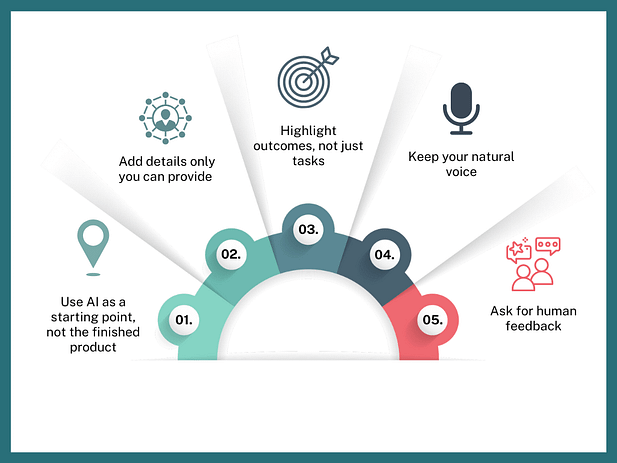
1. Use AI as a starting point, not the finished product
Let AI help you brainstorm or generate a rough structure. Then take ownership. Rewrite in your own words and add details that reflect your actual experiences.
2. Add details only you can provide
AI cannot know that you redesigned a process that cut costs by 15% or that your customer service approach reduced complaints by half. Include specifics that only you can supply.
3. Highlight outcomes, not just tasks
AI tends to focus on responsibilities. Employers want results. Replace “Responsible for team scheduling” with “Led scheduling process for a 15-person team, reducing overtime costs by 20%.”
4. Keep your natural voice
A resume should sound professional but not mechanical. Write the way you would explain your achievements to a hiring manager in conversation. Skip jargon that does not reflect how you really speak.
5. Ask for human feedback
AI cannot tell you how your resume feels to a reader. A mentor, colleague, or career coach can. Human feedback helps ensure your story comes through clearly and authentically.
Striking the Right Balance
So should you use AI for resumes? Yes, but strategically. AI is useful for:
-
Generating formatting ideas.
-
Suggesting action verbs.
-
Catching grammar issues.
-
Helping organize sections.
But the story itself, the narrative of your achievements, your progression, and your impact, must come from you. Think of AI as scaffolding. It can hold the structure together, but you build the walls and give it character.
Bridget’s Takeaway
AI is powerful, but it should never replace your professional story. If you let AI write your resume, you risk erasing the very details that make you memorable.
A strong resume is not about sounding like everyone else. It is about showing who you are, what you have accomplished, and how you can contribute. Use AI as a tool, not a substitute. Add the results, context, and personality that only you can provide. That is how you stand out, earn interviews, and move forward in your career.
Bridget Batson, CMRW, CERM, CGRA, CPRW, NCOPE, CEIP is a Certified Master Resume Writer (CMRW), Certified Executive Resume Master (CERM), Certified Graphic Resume Architect (CGRA), Certified Professional Resume Writer (CPRW), Nationally Certified Online Profile Expert (NCOPE), Certified Employment Interview Professional (CEIP), Myers–Briggs STRONG® Administrator, Previous Fortune 500 Recruiter, and Owner of Houston Outplacement. Available for Individual Consultations at Houston Outplacement
 Connect with her on LinkedIn

